

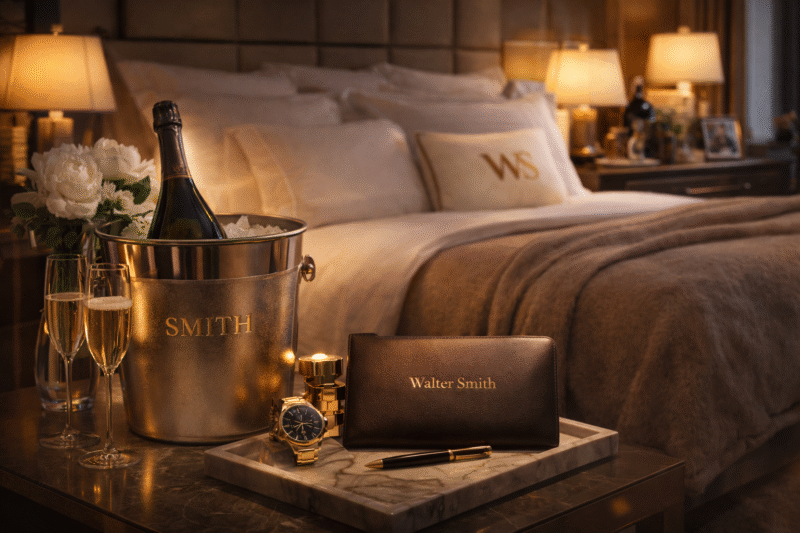
If luxury in the 2010s was defined by scarcity and the 2020s by experiences, then 2026 belongs to something far more intimate: ultra-personalisation. Not the superficial type that swaps your name onto a bottle or engraves your initials on a handbag, but the deeper, more intelligent form that shapes itself around your identity, behaviours, health, choices, history and desires. This is luxury reimagined—alive, adaptive and almost impossibly specific.
Across the world’s wealth capitals—from London and Dubai to Singapore and Los Angeles—the affluent are no longer dazzled by opulence alone. They want relevance. They want precision. They want products and services that feel as though they were designed for them and only them. In this new era, exclusivity comes not from a high price tag but from the feeling that the brand understands you better than you understand yourself.
The Shift From Personal to Predictive
Luxury brands have always offered a certain level of personalisation—tailoring, private shopping, bespoke services—but 2026 marks a turning point because the technology has finally caught up with the ambition. Artificial intelligence, biometrics, behavioural data, neuroscience and advanced materials have converged to make personalisation not simply custom, but predictive.
Hermès, for example, has quietly expanded its experimental approach to bespoke leather goods, using patterns of customer preferences to recommend combinations before the client even walks through the door. While Hermès remains famously private, industry analysts such as The Business of Fashion continue to track the influence of hyper-personalised luxury:
https://www.businessoffashion.com.
Similarly, high jewellery houses are using machine learning to anticipate design styles, gemstone cuts and colourways that appeal to individual collectors. Watches of Switzerland (https://www.watches-of-switzerland.co.uk) notes that “collectors are increasingly seeking pieces that tell their story—not just the brand’s,” a sentiment that now permeates the broader luxury sector.
The transformation is not exclusive to fashion and accessories. The wellness and hospitality industries have embraced ultra-personalisation with astonishing speed. Longevity clinics such as ZOE (https://joinzoe.com) are creating precision health plans built around microbiome, blood sugar responses and metabolic profiles, while luxury wellness resorts like SHA Wellness Clinic (https://shawellness.com) and Lanserhof (https://lanserhof.com) now build entire itineraries around DNA, sleep patterns and emotional wellbeing.
Luxury is no longer something you acquire. In 2026, it is something that shapes itself around you.
Personalisation Moves Into Homes, Travel and Daily Life
The thirst for customisation has begun to spill into daily life as well. High-end smart homes now “learn” their owners’ preferences in light, scent, temperature and music. The latest systems from Lutron (https://www.lutron.com) and Crestron (https://www.crestron.com) allow homeowners to create nuanced emotional atmospheres—morning clarity, evening tranquillity, inspiration, grounding—programmed with a level of subtlety that was unimaginable a decade ago.
Travel, too, has entered a new realm. Luxury travel designers from companies such as Black Tomato (https://www.blacktomato.com) and Scott Dunn (https://www.scottdunn.com) are curating itineraries based on psychographic data, time-of-year mood analysis and personalised “rest-to-stimulation” ratios. It’s a far cry from the old VIP package. This is travel DNA: trips crafted not simply for who you are, but for who you are becoming.
The hospitality giants are evolving too. Mandarin Oriental (https://www.mandarinoriental.com) has expanded its guest-preference mapping to astonishing detail, while Four Seasons (https://www.fourseasons.com) continues refining bespoke experiences that adapt in real time as a guest interacts with the resort. What you order, when you request it, how you travel between spaces, which scents you gravitate toward—every micro-behaviour becomes a thread in a personalised tapestry.
Why Ultra-Personalisation Has Become the New Status Symbol
The psychology behind this trend is as compelling as the technology itself. What affluent consumers crave now is meaningful uniqueness. They’ve grown weary of the mass-market formula of “premium” goods. The luxury buyer of 2026 is less concerned with displaying wealth and more concerned with expressing identity.
A completely personalised object, service or experience—even if discreet—represents a form of luxury no one else can possess. In an age where everything can be copied, reposted, or replicated with AI, the rarest commodity is something crafted only for you.
This shift reflects a cultural zeitgeist: consumers are seeking intimacy in a world overwhelmed by digital noise. According to McKinsey’s luxury report, personalisation is now one of the top three drivers of customer satisfaction and long-term loyalty in high-value clients:
https://www.mckinsey.com/industries/retail/our-insights.
And as Generation Alpha matures into the next wave of luxury consumers, their expectation for customised, intelligent products will intensify the trend.
Ultra-Personalisation and the New Business Models Emerging Around It
For brands, the move to ultra-personalisation is not merely a marketing angle; it’s a complete restructuring of value creation. Entire business models are evolving to meet this desire for tailored relevance.
In the fashion world, small ateliers and independent designers are thriving by offering genuinely bespoke digital-to-physical garments using tools like CLO 3D (https://www.clo3d.com) that allow clients to “try on” custom pieces before they exist. Meanwhile, beauty brands such as SkinCeuticals (https://www.skinceuticals.co.uk) and Function of Beauty (https://www.functionofbeauty.com) have created diagnostic-led routines built around individual concerns and chemistry.
Boutique automotive brands are also innovating. Rolls-Royce Bespoke (https://www.rolls-roycemotorcars.com/en_GB/bespoke.html) continues to push boundaries in personalised interiors, while BMW and Mercedes are introducing AI-adaptive driving experiences that alter everything from seat pressure to soundscapes based on biometric feedback.
Then there is the explosion of personalised financial and lifestyle management. Private banks and wealth advisers are using behavioural finance models to create “life-design” portfolios that revolve around a client’s long-term values, personality and emotional investment profile. UBS (https://www.ubs.com) and JPMorgan Private Bank (https://privatebank.jpmorgan.com) have both published extensive research on how ultra-personal service now drives retention and new wealth relationships.
Luxury is becoming bespoke at an infrastructural level.
The Ethical and Emotional Side of Hyper-Personalised Luxury
However, personalisation at this scale raises questions about data, privacy and psychological dependence. The more a system knows about a person—their behaviours, tastes, habits, vulnerabilities—the more responsibility falls on the brand to guard that intimacy with respect.
As the World Economic Forum outlines in its data ethics guidelines:
https://www.weforum.org/agenda/2023/10/data-privacy-ai-ethics/
the future of personalisation must be anchored in transparency, consent and clarity over how personal data is used.
Still, the emotional payoff is powerful. Consumers who experience deeply personalised luxury often report feelings of comfort, belonging, recognition and ease. There is reassurance in being understood, and in a world where uncertainty is constant, this familiarity becomes a kind of emotional luxury.
A New Chapter for Luxury
Ultra-personalisation is not a passing trend—it is a restructuring of the luxury landscape. The brands that thrive in 2026 and beyond will be those that embrace intimacy and intelligence at scale, without compromising ethics or humanity. It is a delicate balance, but the rewards are extraordinary: deeper loyalty, stronger advocacy, and a clientele that feels genuinely seen.
The future of luxury is not louder. It is not bigger. It is not necessarily more glamorous.
It is more you.

TSF Reporters
The Successful Founder Magazine is the go to feature-rich magazine for founders on all stages of their entrepreneurship journey .